
Updated:
Volatility vs RTP: Key Differences in Pokies
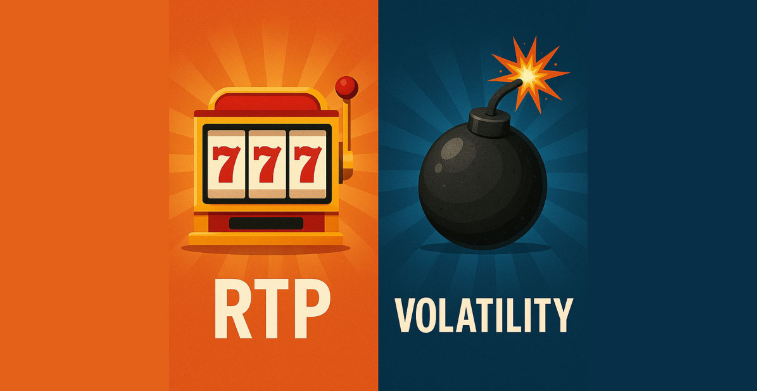
Volatility vs RTP is the one comparison every pokies player should get straight: RTP tells you how much a game returns on average over a very long run, while volatility tells you how unevenly that return is paid out along the way. One number is about value, the other is about the ride.
Both appear in game rules and reviews, and both are easy to misread. If you want a deeper look at the volatility side on its own, start with our explainer on volatility meaning pokies. This guide puts the two numbers side by side, uses real game data to show how they interact and explains how to use both when you choose a game.
Volatility vs RTP: The Short Answer
So, what is the difference between rtp and volatility? RTP is the percentage of all money staked that a game is designed to pay back over millions of spins. Volatility describes how that money comes back: in frequent small wins or in rare large ones. A game can have a high RTP and still be very volatile.
| RTP | Volatility | |
|---|---|---|
| What it measures | Long-run average return | Spread of results around that average |
| How it is shown | A percentage, for example 96.21% | A label or scale: low, medium, high |
| Time frame | Millions of spins | Your session and the next few hundred spins |
| What it tells you | The built-in cost of play | How bumpy the ride will feel |
| Can it vary for one game | Yes, operators may choose between versions | Set by the game design |
What RTP Measures
RTP, or return to player, is the theoretical share of total stakes a game pays back over its lifetime, calculated by the studio and tested by independent labs. A 96% RTP implies an average cost of about 4 cents per dollar staked over a very long run, but it says nothing about any single session.
- It is an average, not a promise. Your session can land far above or below it.
- It is long-run. Studios measure it across millions or billions of simulated spins.
- It reflects the house edge. 100% minus RTP is the built-in margin.
- It is tied to a version. Many games ship with several RTP settings.
In any volatility vs RTP comparison, RTP is the fixed long-run figure; volatility decides how you experience it.
What Volatility Measures
Volatility measures how widely individual results spread around the RTP. Low volatility means most spins land close to the average, with small, frequent wins. High volatility means long runs below the average, offset by occasional very large wins that pull the long-run figure back up to the published RTP.
- Low: frequent small wins, slow and steady changes in balance.
- Medium: a mix of regular wins and occasional larger features.
- High: long quiet spells, with most of the value held in rare features.
If the third group sounds appealing, our guide to high volatility pokies covers bankroll sizing for those swings. In the volatility vs RTP equation, this is the number that decides how much budget you need to see a game’s average play out.
Same RTP, Different Ride: Real Examples
The clearest way to see volatility vs RTP in action is to compare games with similar RTPs and different volatility grades. The table below uses published data checked in November 2026. Several games sit within a percentage point of each other on RTP while ranging from low to high volatility.
| Pokie | Provider | RTP (published) | Volatility | Max win |
|---|---|---|---|---|
| Starburst | NetEnt | 96.09% | Low | 500x |
| Wolf Gold | Pragmatic Play | 96.01% | Medium | 2,500x |
| Book of Dead | Play’n GO | 96.21% (default) | High | 5,000x |
| Dead or Alive 2 | NetEnt | 96.82% | High | 111,111x |
| Blood Suckers | NetEnt | 98% | Low | 1,014x |
| Book of 99 | Relax Gaming | 99% | High | see game rules |
Starburst, Wolf Gold and Book of Dead are within about 0.2 percentage points on RTP, yet they feel completely different to play, which is volatility vs RTP in a nutshell. Book of 99 shows the opposite trap: a 99% RTP with a high volatility grade.
Why the RTP You See May Not Be the RTP You Get
The RTP printed in a review is not always the RTP of the game in front of you. Studios often release several versions of one title, some games tie RTP to the bet level, and bonus-buy features can have their own figure. The only number that applies is the one in the game’s own rules.
- Several versions: Book of Dead is listed at 96.21% by default, with lower versions also in use.
- Bet-dependent RTP: SlotCatalog notes that Mega Joker reaches its 99% figure only at the top bet level, with a much lower figure at the lowest stake.
- Bonus buy: where a buy option exists, check whether its RTP is listed separately.
- Where to check: the last pages of the game rules. Our guide to pokies paytable meaning shows where to find it.
For volatility vs RTP comparisons to be fair, compare the versions you can actually play, not the best figures from a database.
Using Both Numbers to Choose a Pokie
The practical side of volatility vs RTP is simple: use RTP to judge value and volatility to judge fit. Among games you like, prefer the higher RTP version; then pick the volatility level that matches your budget and session goals. Neither number predicts wins, but together they tell you the cost of play and how bumpy the ride will be.
| Your goal | RTP | Volatility |
|---|---|---|
| Long, relaxed sessions on a small budget | Highest version available | Low |
| Balance of frequent wins and occasional features | Highest version available | Medium |
| Chasing large features with a larger budget | Highest version available | High |
| Playing through bonus wagering | Check the bonus terms first | Depends on game weighting in the terms |
Bonus terms can limit which games count towards wagering and by how much. Check the current conditions on our RocketPlay bonus codes page before you apply volatility vs RTP thinking to bonus play.
Common Myths About Volatility vs RTP
Most myths come from mixing the two numbers up. People assume a high RTP means a calm game, that a high-volatility game pays more overall, or that a session result reveals a game’s RTP. None of these hold up, because one number measures value and the other measures distribution.
- “High RTP means low volatility.” Book of 99 and Dead or Alive 2 show it does not.
- “High volatility pays more in the end.” The long-run return is set by RTP, not by volatility.
- “My last session shows the real RTP.” Hundreds of spins are far too few.
- “A game below its RTP is due to pay.” Each spin is independent.
FAQ
What is the difference between rtp and volatility in one sentence?
RTP is how much a pokie returns on average over a very long run, and volatility is how unevenly it returns that money in the short term. That is the core of volatility vs RTP: the first number sets the long-run cost of play, while the second shapes how a single session feels.
Which matters more, volatility vs RTP?
Neither on its own. RTP matters for long-run value, so it is worth choosing the highest version of a game you can find. Volatility matters for your session, so it should match your budget. Most players benefit from checking RTP first and then filtering by volatility.
Do high RTP pokies have low volatility?
Not necessarily. The two numbers are independent. Book of 99 lists a 99% RTP with a high variance grade, while Starburst lists 96.09% with a low grade. If you are wondering what is the difference between rtp and volatility, this is the clearest example: one does not predict the other.
Why do players ask what is the difference between rtp and volatility so often?
Because reviews tend to quote both numbers next to each other, and they look like they measure the same thing. They do not. One is a percentage that describes value; the other is a grade that describes risk and rhythm. Treating them as one number leads to poor game choices.
Where can I check a game’s RTP and volatility?
Open the game’s info or help screen: the RTP is usually on the last page of the rules, and many studios show volatility as a word or icon scale. Provider websites and independent databases list both, but the in-game figure is the one that applies to the version you are playing.
Understanding volatility vs RTP helps you choose, but it does not change the house edge. Gambling is for adults 18+ only. If it stops being fun, free and confidential support is available from Gambling Help Online (gamblinghelponline.org.au) or the National Gambling Helpline on 1800 858 858.